
A Breath of Fresh Air
An investigation report into an incident which occurred over Tully airport, Queensland, Australia, published very recently, recalls a past similar incident which, again, had potential for a tragic ending but, thanks to the skills of those involved, thankfully did not have grave consequence. The latest report highlights the commendable actions, “in difficult circumstances, the pilot managed to control the aircraft and return to land safely”, as well as, “P1 was able to untangle the lines and regain sufficient control of the main parachute to land without further incident.”
The ATSB reports that 10 previous occurrences have been reported since 2001 in which a parachutist struck the aircraft.
Read the full ATSB report here:
https://www.atsb.gov.au/publications/investigation_reports/2025/report/ao-2025-057
On August 1, 2024, a routine parachute drop flight turned into a dramatic and unexpected incident over Vannes, France. A Cessna 208 Caravan, operated by École de Parachutisme Sportif de Vannes Bretagne (EPSVB), was climbing to its designated jump altitude when a skydiver was ejected from the aircraft mid-flight due to the untimely deployment of his parachute. The incident, which resulted in injuries to the skydiver and minor damage to the aircraft, has since prompted safety measures and lessons for the skydiving community.
The flight began as planned, with the pilot taking off to conduct two series of jumps—one at 1,200 meters and another at 4,000 meters. On board were the pilot and 14 skydivers, including experienced jumpers, students, and an instructor. As the aircraft climbed to approximately 450 meters, the skydiver seated near the door partially opened it to ventilate the cabin, a common practice during hot summer days. According to the report, temperatures on the ground ranged between 28°C and 30°C, and the door was opened “to create a flow of fresh air inside the airframe.”
What followed was a sequence of events that no one could have anticipated. The skydiver’s pilot chute—a small parachute used to deploy the main canopy—was partially dislodged from its pouch, likely due to friction between the leather ball handle and the aircraft floor. The airflow from the partially open door then pulled the pilot chute completely out, triggering the deployment of the main canopy. The report describes how the aerodynamic forces “first pulled the skydiver backwards, towards the rear door jamb and then through the vertical sliding door slats.”
The skydiver suffered significant injuries during the ejection. He fractured his tibia upon striking the aircraft structure, and subsequently sustained fractures to five lumbar vertebrae upon landing. Despite these injuries, he managed to control his reserve canopy, which had deployed after the main canopy’s right-hand riser was severed during the incident. The report notes that he “kept the two canopies away from each other” to prevent entanglement and successfully landed on the ground.
The pilot of the aircraft, unaware of the exact nature of the incident, noticed abnormal vibrations and a loud noise during the climb. He initially suspected a mechanical failure and decided to curtail the flight, landing the aircraft a few minutes later. It was only upon reaching the parking stand that he learned a skydiver had been ejected. The pilot immediately alerted control services, and rescue operations were swiftly activated. The skydiver was located, and attended to, by emergency services.
Damage to the aircraft was minor but notable. The vertical sliding door was damaged, with several slats dislodged of their guiding slides, while the skin of the aircraft near the rear door jamb was deformed. Additionally, rub marks were observed on the left-hand horizontal stabilizer, caused by contact with the reserve canopy. The report highlights the potential danger of such incidents, stating that “the untimely opening of a parachute at the door of an aeroplane in flight presents a major risk of the parachute canopy interfering with or snagging on the horizontal stabilizer or elevator, which could lead to the total loss of control of the aeroplane.”
The investigation into the incident revealed several contributing factors. The skydiver had checked his equipment before and after partially opening the door and reported no anomalies. However, during the climb, the instructor responsible for student jumps began checking the parachutes of two students seated nearby. This required slight movements from the skydivers seated next to the door, which may have inadvertently caused the pilot chute to become partially dislodged. The report explains that “the leather ball of the pilot chute of the skydiver sat next to the door was probably squashed between the floor of the aeroplane and the parachute,” leading to its activation.
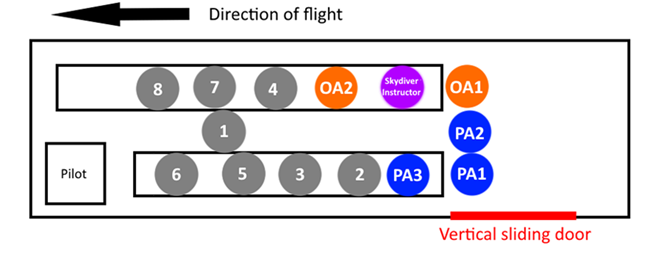
The skydiving centre had procedures in place to mitigate risks during flights, including equipment checks on the ground and during the climb. However, the risk of a parachute deploying when the door was partially open during the climb had not been identified. The report emphasizes that “although this risk had been identified and was the subject of specific procedures […] the risk of the untimely opening of a parachute when the door was partially open during the climb had not been envisaged.”
In response to the incident, the skydiving centre implemented new safety measures. The partial opening of the door during flight, outside of designated drop phases, has been prohibited. The centre also updated its operational checklist to reflect this change. The report underscores the importance of these measures, noting that “the position of a skydiver in line with the aeroplane door and according to the direction in which they are sat […] may directly expose the pilot chute to the airflow generated by the partially open door.”
For the skydiving community, the lessons from this occurrence are clear. Equipment checks must be thorough and ongoing, and the potential for unexpected interactions between gear and the aircraft environment must be carefully considered. The report advises that “in addition to standard checks, it is good practice to check the position of the handles when there has been movement in the aeroplane and before approaching the aeroplane door to jump.”
“The risk of the untimely opening of a parachute when the door was partially open during the climb had not been envisaged”
The story of the ejected skydiver is one of resilience and quick thinking in the face of adversity. Despite the traumatic sequence of events, he managed to land safely, preventing further complications from the interaction between his main and reserve canopies. His actions highlight the importance of training and preparedness in handling emergencies.
As for the pilot, his decision to land the aircraft, immediately upon noticing anomalies, likely prevented further risks to those on board. His experience as a skydiving activity pilot, with over 5,500 hours logged, undoubtedly contributed to his ability to manage the situation effectively.
Read the full BEA report here:
https://bea.aero/fileadmin/user_upload/F-HVPC_EN.pdf