A Gradient Too Steep
On the morning of October 6, 2023, Calgary International Airport (CYYC) witnessed an incident that underscores the critical importance of communication, training, and technology in ensuring aviation safety.
Two aircraft tow vehicles operated by Airport Terminal Services (ATS) inadvertently entered an active runway, creating a risk of collision with a departing Jazz Aviation flight. The Transportation Safety Board of Canada (TSB) conducted an investigation into the incident, releasing its findings in July 2025. The report sheds light on the factors that led to the runway incursion, and highlights the systemic issues that need to be addressed to prevent similar occurrences in the future.
The incident unfolded shortly before 11:00 AM, as two ATS tugs were tasked with repositioning an aircraft, parked on Runway 26, to Apron 5. The lead tug driver received instructions from the ground controller to proceed south on taxiways C, C1, and Y, and hold short of Runway 26. However, these instructions were amended shortly after, directing the tugs to enter Taxiway C2, and give way to an aircraft taxiing north on Taxiway C. The lead driver read back the instructions, including to hold short of Runway 17R.
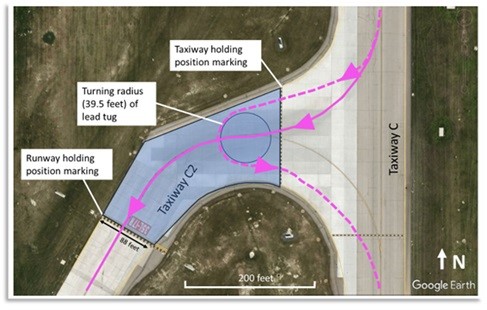
As the taxiing aircraft passed, the ground controller instructed the lead tug driver to continue on Taxiway C and hold short of Runway 26. At 11:04, the two tugs proceeded onto Runway 17R, where a Jazz Aviation, De Havilland DHC-8-402, aircraft was beginning its take off roll. The flight crew noticed the tugs on the runway but decided to continue the take-off, considering it the safest option given the aircraft’s proximity to decision speed. The aircraft became airborne approximately 3,700 feet laterally away aircraft’s proximity to decision speed. The aircraft became airborne approximately 3,700 feet laterally away from the tugs and passed overhead at an altitude of 350 feet as the vehicles exited the runway.
The TSB investigation finds that the incident was not caused by mechanical or technical malfunctions, but rather because of human factors, including procedural drift, conflicting mental models, and a steep authority gradient between the air traffic controller and the tug driver. The report also highlights the role of the advanced surface movement guidance and control system (A-SMGCS), which was offline for a planned software update at the time of the incident.
One of the key findings of the investigation was the lack of recurrent training for tug operators. The lead tug driver held an Airside Vehicle Operator’s Permit (AVOP), which grants specific driving and aircraft-towing privileges on the airfield. However, the AVOP program at CYYC does not feature a retraining component, meaning that once the permit is issued, holders are not required to revisit the material or demonstrate their proficiency during its five-year validity period. The report notes that the driver diverted from the laid down procedure, most probably from “procedural drift”.
This procedural drift was compounded by the lead tug driver’s mental model of the situation, which conflicted with the ground controller’s expectations. The driver believed that turning around on a taxiway was not allowed, unless explicitly instructed by the controller. This impression, combined with his proximity to the runway holding position marking, and his previous experience of making detours onto runways during construction work, led him to conclude that entering the active runway was the only viable option. The report states, “The ground controller’s mental model was that the lead tug driver would continue the route the controller had instructed. This was contradictory to the lead tug driver’s mental model in which the only way to continue the route was to enter [the active] Runway.”
Another critical factor was the steep authority gradient between air traffic controllers and ground vehicle operators. The report explains that this gradient is inherently steep due to the differing nature of their roles. Controllers are tasked with monitoring and ensuring the safe movement of all vehicles and aircraft within their area of control, while ground vehicle operators are responsible for their own vehicles and following instructions. However, a too steep gradient can lead to situations where ground vehicle operators feel uncomfortable seeking clarification when they find a controller’s instructions unclear. The report warns, “If the authority gradient between an air traffic controller and a ground vehicle operator is not proactively managed, a ground vehicle operator may not feel comfortable asking for clarification if he or she considers an instruction to be unclear or erroneous.”
The investigation also examined the impact of the A-SMGCS outage on the incident. The system, which provides real-time surveillance of aircraft and vehicle traffic on airport manoeuvring areas, was offline for a planned software update at the time. To mitigate the loss of this critical tool, the control tower implemented a simplified movement posture which increased spacing for arriving and departing aircraft, and designated specific runways for landings and take offs. However, the report notes that relying primarily on additional time and aircraft spacing during A-SMGCS outages could increase the risk of hazardous situations, like runway incursions.
“A ground vehicle operator may not feel comfortable asking for clarification if he or she considers an instruction to be unclear or erroneous”
Finally, the investigation highlighted the importance of using correct air traffic control phraseology in safety-critical situations. When the tower controller issued an instruction to abort the take-off, the phraseology used was not consistent with the NAV CANADA Manual of Air Traffic Services, “(aircraft id), ABORT, ABORT, (aircraft id) ABORT, ABORT [reason].” As a result, the flight crew did not recall hearing the instruction, likely due to the high workload they were experiencing during the take-off. The report emphases, “If air traffic controllers do not use the correct phraseology for safety-critical situations, there is a risk that the consequences of these situations could be more severe.” It is to be noted that the recommended NAV CANADA phraseology differs from that mandated in ICAO Doc 4444, Procedures for Air Navigation Services, Air Traffic Management, “… to stop a take-off after an aircraft has commenced a take-off roll – STOP IMMEDIATELY [(repeat aircraft callsign) STOP IMMEDIATELY].”
The report concludes that reducing the risk of runway incursions is a complex issue that requires collaboration across the air transportation industry. “There is no single solution that will reduce the risk of runway incursions,” the report states. “Rather, solutions tailored for each airport, in combination with wider-reaching technological advancements such as in-cockpit situational awareness aids and runway status lights, may be more effective.”
This, and similar post-incident investigation reports, keep reinforcing the importance of robust training programs, effective communication, and reliable technological support in ensuring aviation safety. The risk of collisions from runway incursions remains a pressing issue that demands ongoing attention and action from industry stakeholders. Until effective defences are implemented, and the rate of runway incursions demonstrates a sustained reduction, the safety of the air transportation system will remain at risk.
Read the full Transportation Safety Board of Canada [TSB] report here:
https://www.tsb.gc.ca/sites/default/files/2025-07/A23W0122-ENG.pdf