
The National Transportation Safety Board (NTSB) investigation examined a ground collision involving a Hawaiian Airlines Boeing 717 at Kahului Airport in Maui, Hawaii. The event occurred on 30 November 2023, when the aircraft struck a tow tractor during pushback from the gate. Although the aircraft sustained only minor damage, and most occupants were uninjured, the accident illustrates how multiple small failures across different layers of a safety system can align and lead to an incident. Viewed through the Swiss Cheese model of accident causation, this was a classic case where several deficiencies [holes] in operational procedures, communication, and situational awareness lined up, allowing the collision to occur.
According to the investigation, the aircraft, Hawaiian Airlines Flight 105, had completed boarding and prepared to push back from the gate in rainy, low-visibility conditions early in the morning. During the pushback process, the tow tractor operator was moving the aircraft away from the gate while the flight crew prepared the aircraft for taxi. Shortly afterward, the aircraft collided with the tractor, causing minor damage to the airplane and minor injuries to one ramp worker.
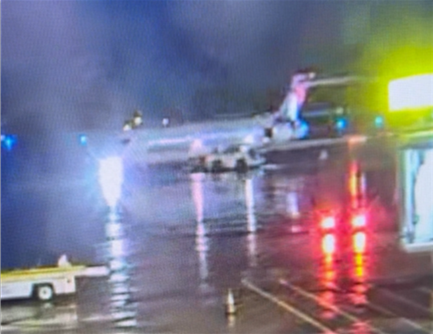
The report describes the circumstances at the time of the event, noting that “after obtaining pushback clearance from air traffic control, they released the airplane’s brakes and the tow tractor operator began to push the airplane back from the gate.” The captain stated that the environmental conditions were challenging, reporting, “it was dark outside and raining.” These details are significant because they highlight the operational context in which the crew, and ground personnel, were working. Reduced visibility and early-morning operations can increase the likelihood of human error, particularly when combined with workload pressures or procedural deviations.
Another important factor described in the report was the aircraft’s mechanical status. The captain reported that one of the aircraft systems was inoperative, requiring additional procedures during the pushback process. Specifically, the report notes, “due to an inoperative engine auto starter, the captain was required to perform the manual engine start procedure.” This added task increased cockpit workload at a critical moment when the aircraft was being maneuvered on the ground.
Using James Reason’s Swiss Cheese model, the collision can be understood to be the result of multiple layers of discrete defences failing simultaneously. In aviation operations, several safeguards normally prevent such accidents. These include standard operating procedures, crew resource management, communication protocols between cockpit and ground crew, and environmental awareness. Each of these layers acts like a slice of cheese in the model, designed to prevent hazards from progressing further. However, each layer can contain weaknesses or “holes”, which, if they line up across several layers, an accident pathway emerges.
The first layer in this case involves organizational and procedural defences. Ground operations procedures are intended to ensure that pushback and taxi operations occur in a coordinated and controlled manner. However, the report indicates that additional cockpit workload was present due to the manual engine start procedure. When normal automated systems are unavailable, crews must compensate by performing additional actions. This increases the likelihood that attention will be diverted from external monitoring tasks. In the Swiss Cheese framework, this represents a latent condition: the aircraft system malfunction created a vulnerability in the operational environment.
The second layer concerns human performance and workload management. The captain’s need to conduct the manual engine start meant that cockpit attention was divided between internal tasks, and external monitoring of the pushback operation. During ground movements, pilots rely heavily on communication with ground crew and visual awareness of surrounding equipment. However, performing a manual engine start procedure during pushback may have reduced the crew’s capacity to monitor the situation outside the aircraft. This illustrates a classic human-factors deficiency: tasks that compete for attention during critical phases of operation.
Another layer involves communication between the cockpit and ground personnel. Pushback operations require clear coordination between the flight crew, and the tow tractor operator. Any misunderstanding about the aircraft’s readiness to move, or the ground equipment’s position, can create a hazardous situation. The report indicates that situational awareness between the aircraft and the tractor operator may have been incomplete. Although the report does not attribute the event to a single communication failure, the collision itself indicates that coordination broke down at some point during the manoeuvre.
Environmental conditions represent another layer in the Swiss Cheese model. The report highlights that it was dark and raining at the time of the incident. Low visibility can reduce the ability of both pilots and ground personnel to visually detect hazards. Ground vehicles and equipment may be harder to see, especially when lighting is limited or reflections from rain obscure visual cues. Environmental factors alone rarely cause accidents, but they can enlarge the “holes” in other safety layers, making a delicate situation more prone to errors.
The final layer involves operational monitoring and situational awareness. Even when earlier safeguards fail, accidents can often be avoided if someone detects the hazard in time. In this case, the aircraft and tow tractor came into contact before the situation was corrected. The fact that the collision occurred suggests that although the ground personnel recognized the developing hazard, the aircraft crew did not. The ground personnel were unable to take evasive action in time to avoid an accident.
“Neither crew member appeared to recognize how the demand on mental resources imposed by additional tasks could impact their monitoring and awareness”
From a Swiss Cheese perspective, the event resulted from the alignment of several vulnerabilities: increased cockpit workload due to equipment malfunction, challenging environmental conditions, possible gaps in communication between the cockpit and ground crew, and reduced situational awareness during pushback. Each factor alone might not have caused an accident. However, when combined, they allowed the hazard pathway to pass through multiple safety layers. Other compounding and contributing factors highlighted by the report speak of irregular operation of the yellow flashing light beacon mounted on the roof of the towing tractor, dubious hand “saluting” gestures, missing illuminated wands, and doubtful use of flashing the taxi light.
The report ultimately demonstrates how aviation incidents often arise not from a single dramatic mistake but from a chain of small deficiencies. Mechanical issues, operational procedures, human workload, and environmental conditions all interacted during the pushback operation. When these weaknesses aligned, the result was a ground collision that injured a ramp worker and damaged the aircraft.
Although the consequences were relatively minor compared with many aviation accidents, the investigation highlights important safety lessons. Ground operations are complex environments involving coordination between pilots, ramp workers, and equipment operators. Ensuring that crews are not overloaded with tasks, particularly when systems are degraded, is critical for maintaining safety. Clear communication procedures and strong situational awareness are equally important.
Viewed through the Swiss Cheese model, the accident serves as a reminder that aviation safety depends on multiple overlapping defences. When those defences weaken simultaneously, even routine operations such as pushback can become hazardous. Strengthening each layer—through improved procedures, better workload management, and heightened awareness of environmental conditions—helps prevent similar incidents from occurring in the future.
Read the NTSB Final Report here:
https://data.ntsb.gov/carol-repgen/api/Aviation/ReportMain/GenerateFinalReport/193459/pdf