
Expectation Bias Wins Through
The Transport Safety Investigation Bureau of Singapore (TSIB) recently published its final report following an investigation into a safety incident during a routine departure at Singapore Changi Airport.
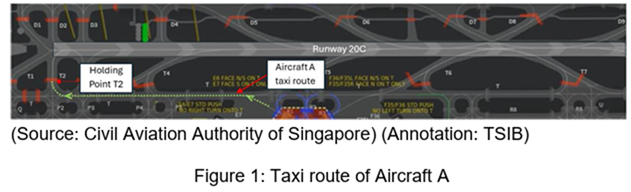
On 19 May 2025, a Malaysia Airlines Boeing 737-800 bearing registration 9M-MLL [referred to as Aircraft A], scheduled to depart for Kuala Lumpur International Airport at 16:35 LT, was instructed to taxi to the holding point on Taxiway T2 for departure on Runway 20C. The Pilot-in-Command (PIC) was taxiing the aircraft, while the Second Officer (SO) was communicating with Air Traffic Control (ATC) through the radio.
As the report recounts, “At about 16:49 LT, the aircraft was cleared to taxi via Taxiway T and Taxiway T2 to the runway holding point on Taxiway T2 for departure on Runway 20C”. While taxiing, the crew switched to the Runway Controller’s (RWC) frequency. The RWC, after confirming the crew was ready, instructed them to line up on Runway 20C. The SO read back the instruction correctly, and the RWC switched off the red stop bar lights at Holding Point T2, facilitating the aircraft’s entry onto the runway. The report notes, “Shortly after the SO had read back the RWC’s instruction, the flight crew of Aircraft A realised that the cabin crew had yet to report to them that the cabin was ready for departure. The PIC informed the RWC that they would need another two minutes before they could depart and that they were holding short of the runway”. In response, the RWC switched the red stop bar lights back on and issued the instruction, “line-up clearance cancelled and report when ready”. A critical miscommunication occurred at this point, as the PIC read back, “cleared line-up and wait,” while the aircraft continued to taxi towards the runway. The report highlights, “The RWC noticed the PIC’s incorrect readback and, in response, instructed the PIC to ‘hold at Holding Point T2.’ From the recording of the ambient microphone at the control tower, the RWC could be heard saying these words immediately after the PIC’s readback. However, a separate audio recording […] showed that only the portion ‘Holding Point T2’ was transmitted to Aircraft A”.
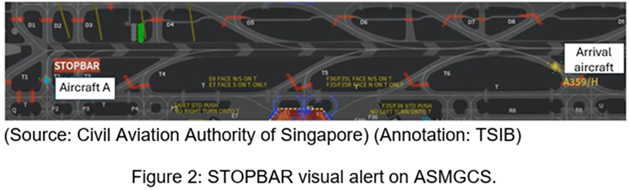
Despite the RWC’s attempt to correct the situation, the truncated transmission led the PIC to believe they has been instructed to line up and wait. The PIC informed the SO that they had the appropriate permission, and the aircraft continued onto the runway. The RWC then received a runway incursion alert from the Advance Surface Movement Guidance and Control System (ASMGCS), indicating that the aircraft had crossed the red stop bar lights without proper authorisation.
The RWC faced a dilemma. The report explains, “The RWC considered instructing Aircraft A to stop and hold at its current position but on second thought felt that there was no need to ask Aircraft A to do so. The RWC reasoned that: Aircraft A had already crossed the Holding Point T2 which is collocated with the red stop bar lights and a runway incursion had already occurred. Having Aircraft A hold at its current position would not remedy the situation; and her plan was to have Aircraft A line up on the runway anyway after the flight crew of Aircraft A had informed her that the aircraft was ready for departure”.
Meanwhile, another aircraft that had just landed was taxiing slowly off the runway. The RWC instructed it to vacate the runway quickly, concerned that “if the arrival aircraft stopped on RET T7 and if Aircraft A initiated the take-off, this would be an unsafe situation as the runway was considered to be occupied so long as the arrival aircraft had not vacated RET T7”. Once the arrival aircraft had vacated the runway, the RWC issued a take-off clearance to Aircraft A. The incident concluded without injury or damage, but it raised important questions about communication, expectation bias, and procedural clarity.
“It is paramount for air traffic controllers to always maintain positive control and to ensure that their instructions are clearly understood and complied with by flight crews”
The investigation found that the PIC’s expectation bias played a role: “The initial line-up clearance issued earlier may have primed the PIC to expect a line-up clearance once the cabin was ready. Thus, when the cabin crew confirmed that the cabin was ready, the PIC’s frame of mind could be that the next instruction from the RWC was to line up on the runway. This expectation bias could have led the PIC to interpret the RWC’s truncated instructions as a clearance to line up on the runway.”
The report also scrutinized the phraseology used by the RWC. While ICAO guidance does not specify exact wording for cancelling a line-up clearance, it does emphasize the use of direct imperative sentences to reduce ambiguity. The report states, “It would be desirable for ATCOs to be made aware that direct imperative sentence structure formulations represent the preferred structural phraseology form and to adopt such structures as far as practicable when issuing instructions in plain language for scenarios not covered in ICAO guidance documents”.
In the aftermath, both the airline and the Air Traffic Service Provider (ATSP) took action. The airline shared the incident with all its flight crews, emphasizing the need to, “always listen attentively to ATC instructions” and to seek verification if communication is interrupted. The ATSP reminded controllers that, “instructions to flight crews shall begin with the immediate action required. Any message on or reason for cancellation of a previous instruction shall come later. For instance, when cancelling a line-up clearance, the instruction should be prefixed with an instruction that emphasises the immediate action required of a flight crew, such as ‘Hold position'”.
The TSIB highlights that, “It is paramount for air traffic controllers to always maintain positive control and to ensure that their instructions are clearly understood and complied with by flight crews”. The incident at Changi Airport serves as a reminder that even routine operations can be vulnerable to expectation bias, ambiguous phraseology, and the challenges of real-time communication.