
Student Commander Faces Challenges Greater Than Ability
On the afternoon of 15 August 2021, in Norway, a student pilot was nearing the end of what had been a successful day in the air. Flying a two-year-old Diamond DA40 NG belonging to Pilot Flight Academy, he had completed a solo navigation exercise that included landings at Hønefoss and Sandefjord before returning to his home base at Notodden Airport. After almost four hours in the cockpit, only one landing remained.
The flight had been planned as part of the student’s training programme. It was his fifth solo flight, requiring him to fly approximately 300 nautical miles, stopping at two airports, before returning to Notodden. According to the investigation by the Norwegian Safety Investigation Authority (NSIA), the journey had progressed without difficulty. Both earlier landings had been completed safely, and “there were no problems on the flight back to Notodden until the first landing attempt.”
However, conditions at Notodden were different from those the student had encountered earlier in the day. Since it was the weekend, the airport’s control tower was not manned, and pilots were coordinating their own movements over the radio. As with all weekends at Notodden, the airport was busy with training aircraft from the academy who were sharing the circuit with gliders.
As the student approached the airport, radio communications became confusing. A glider was transmitting with poor audio quality, making it difficult to establish its exact position. The student repeatedly tried to identify where the glider was, while another academy aircraft relayed what little information it could. Even after entering the circuit, the student continued looking for the glider, but never saw it.
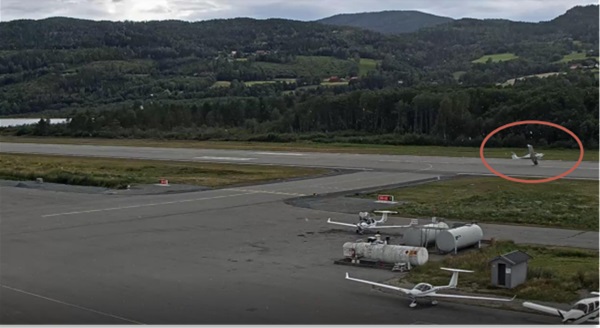
At the same time, the wind was changing. The investigation notes that wind direction had varied significantly during the afternoon, and was now variable, approximately 110 to 150°, resulting in tailwind with a crosswind component for runway 30. This factor created uncertainty about which runway offered the safest landing. The student observed changing wind indications while flying the circuit but also saw that other academy aircraft, each with an instructor on board, were continuing to use Runway 30. As the least experienced pilot in the area, he followed their example.
His first landing attempt did not go as planned. The aircraft approached the runway carrying more speed than intended, and floated above the runway instead of settling onto it. Recognising that the approach was no longer satisfactory, the student abandoned the landing, and climbed away for another circuit.
The decision itself was not criticised by investigators. In fact, they concluded that discontinuing the approach was the right response. The problem did not lie with the decision to go around, but everything that happened afterwards.
During the second circuit, the workload increased further. Another academy aircraft was preparing for departure, requiring the student to circle above the town before making another approach. While waiting, he considered switching to the opposite runway because the wind appeared to favour it, but decided against doing so. He remained concerned about the location of the glider, whose position was still uncertain, and he was also aware that other academy aircraft, with experienced instructors on board, had continued using Runway 30 despite the changing wind.
By the time he lined up for the second approach, the conditions had not improved. Flight data later showed that the aircraft again approached with a tailwind, and at a higher speed than intended. The descent was steeper than normal, and although the student reduced speed before reaching the runway, the approach never became fully stable.
The student later told investigators that the aircraft again floated above the runway. As its speed reduced, it began drifting to one side. He attempted to correct the movement, while simultaneously abandoning the landing by applying full power.
“The situation was too demanding for the commander’s skill level”
The aircraft touched the runway, bounced back into the air, struck its left wing on the asphalt and veered off the runway before coming to rest about 30 metres away on the grass. Emergency services arrived within minutes, and although the pilot escaped without injury, the aircraft sustained extensive damage to its fuselage, landing gear, propeller and engine.
The NSIA concluded that the accident was the result of several factors rather than one decisive error. The investigation found that “unstable wind conditions and distractions linked to the traffic pattern probably contributed” to the student’s inability to establish a stable approach. The combination of changing winds, heavy radio traffic, and uncertainty over the glider’s position created an unusually demanding situation during the crucial final stages of the flight.
Investigators also believed fatigue may have played a part. Although the navigation exercise had gone well, the student had been flying alone for almost four hours before returning to Notodden. Maintaining awareness of changing wind conditions, while simultaneously monitoring other aircraft and making landing decisions, increased the workload at exactly the point where accuracy mattered most.
The report also examined the student’s training history. He had progressed through the academy’s programme but had needed additional instruction after failing an earlier solo assessment twice. Following further training with a single instructor, he passed the required checks and continued into the next phase of training, completing several successful solo flights before the accident.
The investigation raises questions about whether the academy could have provided additional support on the day. With the control tower closed, there was no aerodrome flight information service available to advise pilots about wind conditions or traffic. Investigators suggested that an instructor monitoring the radio from the ground could potentially have helped identify communication problems with the glider, and provided clearer situational awareness to solo student pilots.
Pilot Flight Academy carried out its own internal investigation after the accident and introduced, or reviewed, several safety measures. These included revised procedures for go-arounds, clearer guidance on stabilised approaches and improvements to communication training. The academy also examined how student progress was documented, and how instructors assessed developing pilots during training.
The NSIA’s broader conclusion was that the accident illustrated how several manageable challenges can combine into a situation that quickly exceeds a pilot’s capacity to respond. The report describes the event as “an example of how a landing attempt with too much initial energy and a subsequent missed approach at a low altitude can culminate in a loss of control and an accident.”
Perhaps the most striking observation comes near the end of the report. The investigators wrote that “everything happened very quickly,” and concluded that the student “faced greater challenges than he was able to handle.”
Those words reflect the purpose of the investigation. Rather than assigning blame, the report reconstructs how a routine training exercise developed into an accident during its final minutes. A long and successful navigation flight, changing wind, uncertain radio communication, busy traffic and split-second decisions all formed part of the sequence. Individually, none guaranteed an accident. Together, they left little margin for recovery, providing lessons that extend well beyond a single afternoon at a small Norwegian airport
Read whole NSIA report here:
https://nsia.no/Aviation/Aviation/Published-reports/2022-01?pid=SHT-Report-ReportFile&attach=1