
A Kneeboard in the Works
On July 17, 2021, a Cessna 208B Caravan, registered as G-OJMP, was involved in an accident at Old Sarum Airfield in Wiltshire. The incident occurred during the fourteenth flight of the day, as the pilot was conducting parachuting sorties. While the pilot escaped with minor injuries, the aircraft was damaged beyond economical repair.
The day began with favourable weather conditions, and the pilot had successfully completed 13 flights before the accident. The parachutists were landing on the disused airfield, and the pilot had taken a break after the eleventh flight. However, during the earlier flights, he had been informed by the Drop Zone (DZ) controller about gliders circling near the airfield. Despite being aware of their presence, the pilot was unable to visually locate them, which led to a heightened sense of caution.
On the fourteenth flight, to avoid potential conflicts with the gliders, the pilot decided to fly a shorter final approach path so as to keep the aircraft closer to the airfield and away from the gliders, which were reportedly moving clockwise around the area. To achieve this, the pilot extended the initial descent further than usual, delaying the turn downwind and aiming to be lower when passing the threshold of Runway 06. The plan was to land at the beginning of the runway, which had a pronounced upslope, rather than on the flatter section used during previous landings.
As the aircraft descended on the downwind leg, the pilot’s A5-sized metal kneeboard, which he used to record flight details, slipped from under his flight bag into the right footwell. Initially dismissing this as a minor inconvenience, the pilot continued with the circuit and began configuring the aircraft for landing. However, as the aircraft approached the final descent, the pilot became concerned that the kneeboard might obstruct the rudder pedals during landing on the narrow runway. At approximately 200 feet above the airfield, the pilot decided to retrieve the kneeboard from the footwell.
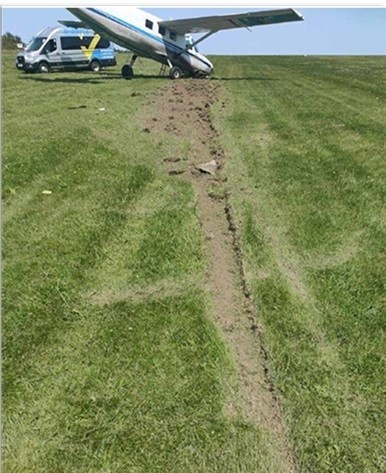
This decision proved to be a critical error. The pilot admitted that he had checked the aircraft’s flight path before reaching for the kneeboard, but when he looked up again, he realized the aircraft was much lower than expected. In his own words, he described his reaction as a “lifesaving manoeuvre,” abruptly pitching the aircraft up to arrest the rate of descent. Unfortunately, the aircraft touched down hard in a field just two meters short of the airfield boundary. It then crossed a small berm, causing the nose-wheel to collapse, and coming to rest within the lateral confines of the runway.
The pilot sustained minor injuries, including two small cuts to his chin caused by his oxygen mask. He managed to exit the aircraft unassisted through the pilot’s side door after securing the engine and shutting down the aircraft systems. Upon exiting, he noticed that the flaps were up and speculated that he might have forgotten to lower them during the landing due to the distraction caused by the fallen kneeboard.
Reflecting on the incident, the pilot admitted to several habits that may have contributed to the accident. He revealed that he had developed a tendency not to wear the shoulder straps of his five-point harness, as he felt they restricted his movement in the cockpit. This habit, he explained, was born out of the need to frequently look over his shoulders during parachuting flights. However, he acknowledged that not wearing the shoulder straps left him vulnerable during the hard landing, as he was bent double over the control column and unable to straighten his upper body or raise his head. “In future, I will always secure the shoulder straps,” he stated.
The pilot also noted that he typically extended the flaps just before rolling out on the final approach and performed additional checks to ensure the aircraft was properly configured for landing. However, the distraction caused by the kneeboard prevented him from completing these critical tasks. He admitted, “While I am not certain I landed with the flaps retracted, I believe I probably did.”
The pilot’s decision not to perform a go-around was another factor in the accident. He explained that his focus on retrieving the kneeboard prevented him from considering this option. Additionally, he believed that a go-around might have introduced further risks, as the parachutists were still landing on the airfield at the time. He also expressed concern that the kneeboard could have caused a restriction on the rudder pedals during a go-around, potentially leading to controllability issues.
“The shorter circuit pattern gave him less time to deal with any possible distractions during the approach”
The pilot’s comments shed light on the challenges he faced during the flight. He explained that he had created his own kneeboard because the aircraft’s technical log was too large to record flight details during operations. However, he chose not to strap the kneeboard to his leg, fearing it might restrict the controls. Instead, he stowed it under his flight bag on the co-pilot’s seat, a decision that ultimately contributed to the accident. Reflecting on the incident, the pilot recommended that the operator redesign the technical log so it could be secured to a pilot’s leg without causing control restrictions. With hindsight, he also suggested that pilots should establish a stable approach no closer than half a nautical mile from the runway threshold.
The analysis of the accident emphasized the importance of prioritizing the task of flying the aircraft, especially during critical stages such as the final approach. The report stated, “Any attempt to recover a loose article from the floor of an aircraft, while maintaining control, would need to be carried out very cautiously. However, doing so during the final 200 ft of an approach required the pilot to stop concentrating on the key priority of flying the final approach and introduced risk at a critical stage of flight.”
The report concludes that the accident occurred because the pilot became distracted by the fallen kneeboard during the final approach. It suggests that the pilot could have disregarded the distraction and continued to land, or performed a go-around and safely retrieve the kneeboard later. Either option would likely have prevented the accident. The report also noted that the pilot’s decision not to wear the shoulder straps contributed to his injuries and recommended that pilots always secure their harnesses during flight.
This incident serves as an important reminder of the importance of maintaining focus during critical stages of flight while adhering to safety protocols.
Read the full AAIB investigation report here:
https://assets.publishing.service.gov.uk/media/6257dab68fa8f54a8c6522db/Cessna_208B_Caravan_Cargomaster_G-OJMP_04-22.pdf