
Human Factors Behind a Faulty Nose Wheel Job
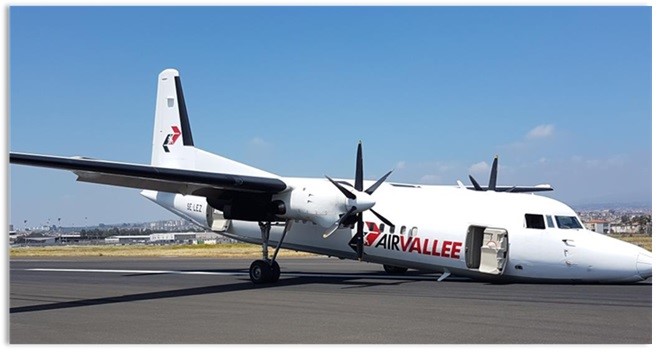
An accident involving a Fokker 50, SE-LEZ, at Catania Airport on 30 April 2016, was the result of a landing-gear problem that had developed during maintenance carried out the previous day. Four passengers sustained minor injuries, and the aircraft was substantially damaged when it landed with its nose landing gear retracted.
“work carried out without using the existing procedures […] even though these procedures were printed and available where the work was carried out […] the required tools were not used due to their unavailability”
The technical failure was relatively straightforward, components within the nose landing gear had been incorrectly installed during maintenance at Bergamo Airport. On the other hand, more complex circumstances had allowed those errors to occur
The investigation by Italy’s Agenzia Nazionale per la Sicurezza del Volo (ANSV) identified a number of human and organisational factors, including limited experience among some of the maintenance personnel, unclear allocation of tasks, inadequate supervision, time pressure and shortcomings in the way the maintenance instructions were used.
This accident provides a useful example of how human error in aviation is rarely the result of one isolated mistake. More often, several weaknesses combine and allow an error to remain undetected.
On 29 April, SE-LEZ arrived at Bergamo from Tirana with a maintenance requirement affecting the nose landing gear. Three maintenance technicians were assigned to the task. The aircraft remained at Bergamo for 4 hours and 25 minutes. However, the investigation calculated that only some three and a half hours were available for the maintenance activities. One of the technicians described the circumstances as involving “considerable pressure and hurry in order to have the aircraft ready as soon as possible, in order to land on Rimini and allow the crew to have rest time as scheduled”, for the aircraft to operate the following day’s flight to Catania.
The ANSV considered this operational pressure as an important factor in the way maintenance was carried out. Time pressure does not necessarily cause an error by itself, but rather that it can reduce the opportunity to stop, consult documentation, seek assistance, or carry out additional checks.
The three technicians did not have the same level of experience with the particular maintenance operation.
One technician had previously carried out the relevant seal-replacement work, while other two had never performed that task before.
The investigation found that responsibilities within the team were not clearly established at the beginning of the work. One technician stated that “no team leader had been appointed and no maintenance tasks had been assigned”. This lack of clearly defined responsibilities became important when the experienced technician was subsequently called away to deal with other work. During his absence, the other technicians continued with the maintenance. When the experienced technician returned, some of the critical work had already been completed, and could not be checked by the more experienced professional.
The ANSV considered the absence of an effective division of responsibilities to be one of the factors that contributed to the errors. It also identified the limited experience of two of the technicians as a relevant factor, since the task was being performed by personnel without appropriate experience, and without an appropriate level of supervision.
A further human-factor issue concerned the certification and checking of the work. One of the technicians, who had not previously performed the particular operation, acted as certifying staff. The investigation found that, in fact, he had not checked all of the work carried out by the other technicians. The report points out that “double or independent supervision would have been essential” in the circumstances, significantly, because an independent check would have provided an opportunity to identify the incorrect installation before the aircraft was returned to service.
The ANSV ultimately concluded that effective supervision could have prevented the accident. Its final report states, “Supervision or control of these activities by a maintenance person capable of performing effective control would almost certainly have prevented the errors from being committed”. The sobering distinction lies between completing a certification requirement, and providing effective supervision. The presence of a qualified person does not necessarily mean that the work has been independently, and adequately, checked.
The investigation also examined how the maintenance documentation was used. The applicable procedures were available to the maintenance personnel, although it was pointed out that the relevant instructions had not been adequately followed during the work.
There were also questions concerning the presentation of some of the information. One technician reported that the procedure available to him had been printed in black and white. The original documentation contained an amber warning, and the investigators noted that, if the copy had indeed been printed in black and white, the warning would have been “much less visible”. On its own, this was not identified as the sole cause of the accident, but rather as yet another factor affecting the way information was presented to the people performing the work.
The investigation also noted that some of the instructions could have provided clearer information about the correct orientation, and installation, of components. Following the accident, changes were made to the maintenance documentation, including the addition of clearer instructions and illustrations.
The investigation uncovered that maintenance work was carried out without all of the specified tools being available since they were not available at the time. Alternative [not necessarily improper] tools had to be used during the work.
Again, this was not treated as a single cause of the accident. It was only one part of the wider working environment in which the maintenance was performed. The combination of limited time, inexperienced personnel, incomplete supervision, and the absence of the specified tools reduced the safeguards available to the maintenance team.
The maintenance errors were not apparent to the flight crew when SE-LEZ departed on 30 April. During the flight, the crew eventually received indications that the nose landing gear had not extended correctly. They followed the applicable procedures, attempted the available methods for obtaining a normal gear indication, and coordinated with air traffic control.
A low pass was carried out so that the landing gear could be visually inspected from the ground. The crew subsequently carried out further attempts to resolve the problem before preparing for a landing with the nose landing gear retracted.
The ANSV concluded that the flight crew conducted the flight “in accordance with the rules and procedures applicable” to the situation. This is relevant to the human-factors analysis because it distinguishes the errors made during maintenance from the actions taken by the flight crew after the problem became apparent. The pilots were dealing with a condition created during the previous day’s maintenance.
The SE-LEZ accident demonstrates why aviation investigations generally look beyond the immediate technical failure. Although the incorrect installation of components was the direct cause of the landing-gear problem, the investigation identified several conditions that contributed to the errors occurring and remaining undetected.
None of the identified factors, on its own, necessarily had to result in an accident. In a well-functioning safety system, one safeguard should compensate when another is weakened. In this case, several safeguards were simultaneously weakened.
The investigation’s findings illustrate an important principle of human factors in aviation, that an error made by an individual is only part of the story. The working environment, organisational arrangements, procedures, and supervision all influence whether that error is detected, or allowed to affect the operation. For SE-LEZ, the maintenance error was not discovered before the aircraft departed Bergamo. The flight crew subsequently had to manage its consequences at Catania.
The accident was therefore not simply a case of a component being installed incorrectly. It was the result of a maintenance task being performed in circumstances where several opportunities to identify, and correct, the error were missed.
Read the whole ANSV report here:
https://ansv.it/wp-content/uploads/2021/09/Final-Report-SE-LEZ-1.pdf