
The Anguish of a Potential Accident Lasts Longer than the Satisfaction of a Quick-Fix
This report examines a serious incident involving a Piper PA-22-108, registration G-ARNE, which occurred at Old Buckenham Airfield, Norfolk, on 23 May 2025.
The aircraft, manufactured in 1961 and powered by a single Lycoming O-235-C1B piston engine, was being flown privately by a 55-year-old pilot holding a Private Pilot’s Licence. At the time of the incident, the pilot had accumulated 293 hours of flying experience, with 36 hours on this particular type. There were no passengers on board, and no injuries were reported.
Shortly after take off, and at approximately 400 feet above ground level, the pilot heard a distinct ‘clunk’ and felt a jolt through the aircraft. This unexpected event prompted the pilot to conduct a troubleshooting scan of the aircraft. He observed that the outboard end of the left aileron had partially detached from the wing. The pilot, uncertain about the extent of the damage and the potential impact on the aircraft’s controllability, declared a MAYDAY. He maintained a steady climb and made gentle control inputs to assess the aircraft’s handling characteristics. Noting that he could still manoeuvre the aircraft, primarily using rudder inputs, the pilot decided to attempt a return to Old Buckenham Airfield. Skilfully executing a wide circuit to avoid populated areas and to minimise further aileron control inputs, he ultimately made a successful landing on Runway 07. Upon inspection it was discovered, “that the left outboard aileron hinge clevis pin was missing.” Additionally, the hinge bracket through which the clevis pin would have been fitted was found to be worn. The aircraft repair organisation further identified that the equivalent clevis pin on the right aileron was a non-standard part, with a larger diameter than specified by the manufacturer. The report provides photographic evidence, explaining, “Assessment by the aircraft repair organisation identified that the equivalent clevis pin on the right aileron was a non-standard part and had a larger diameter than the part specified by the aircraft manufacturer, and that the hinge bracket was also worn.”
“In this case a work-around was used to allow the aircraft to operate without use of the specified parts or correct repairs”
The maintenance history of the aircraft did not reveal when the pin had been replaced, suggesting that the use of non-standard parts pre-dated the current ownership. The analysis section of the report speculates that, “With the hinge brackets showing signs of wear, it is likely that oversized replacement clevis pins were manufactured, or non-standard pins found, to fit the worn hinge holes and negate the need to replace the hinge brackets.” This practice, while perhaps expedient, bypassed the manufacturer’s specified maintenance procedures, and may have contributed to the incident.
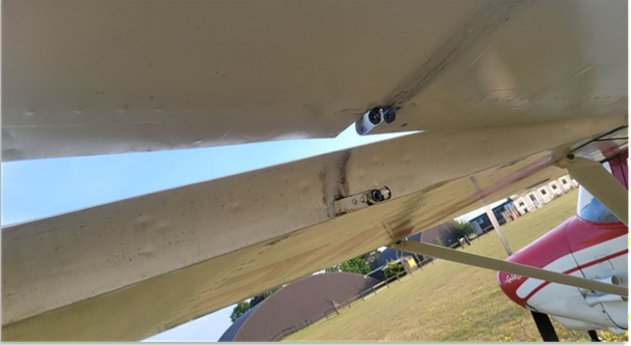
The report underscores the importance of adhering to manufacturer specifications for replacement parts, “Aircraft manufacturers specify parts to fulfil design requirements, such as operating loads, fatigue life and corrosion resistance. They are designed to operate through the life of the aircraft or, if maintained on-condition, replaced when inspections reveal they are failing or worn out.” The use of non-standard parts, as was the case here, can undermine the airworthiness of the aircraft, and lead to premature component failure. The report further notes, “To maintain the airworthiness of the aircraft, replacement parts must be those specified by or repaired in accordance with the manufacturer’s manuals and instructions. It seems that in this case a work-around was used to allow the aircraft to operate without use of the specified parts or correct repairs, possibly leading to a premature component failure.”
The pilot’s response to the emergency is commended in the report, “The action taken by the pilot to calmly and methodically troubleshoot and identify the issue, before applying a threat-and-error-management strategy is good practice when responding to in-flight emergencies.” By minimising aileron control inputs and relying more on the rudder, the pilot reduced the loading on the compromised aileron, thereby lessening the risk of it detaching completely during flight.
Proper maintenance practices in aviation is crucial. The temptation to use non-standard or improvised parts, especially in older aircraft where wear and tear may be more pronounced, can have serious consequences. The report’s findings suggest that the use of an oversized or non-standard clevis pin was a workaround to avoid replacing worn hinge brackets. While this may have restored functionality in the short term, it ultimately compromised the integrity of the aileron attachment, and led to the in-flight failure. The absence of the clevis pin on the left aileron cannot be definitively explained. The report acknowledges, “Given the absence of the clevis pin, it was not possible to determine whether it was missing because the split pin had been lost, allowing the clevis pin to migrate out of the hinge, or if the clevis pin itself had failed.” However, the presence of non-standard parts and worn brackets strongly suggests that the root cause was related to improper maintenance, rather than a random mechanical failure.
The incident involving Piper PA-22-108 G-ARNE highlights the necessity of using manufacturer-approved parts, and following prescribed maintenance procedures. Happily, the pilot’s skilful handling of the emergency prevented a potentially more serious outcome, but the underlying maintenance issues serve as a cautionary tale for aircraft owners, operators, and maintenance personnel. The Synopsis wraps up with the maxim, “This event serves as a reminder to ensure that when maintaining aircraft the correct parts are used.” The lessons from this incident are clear: adherence to proper maintenance standards is not merely a regulatory requirement, but a fundamental aspect of aviation safety.
Read the whole AAIB investigation report here:
https://assets.publishing.service.gov.uk/media/69ce8ccb40178298997eeff8/Piper_PA-22-108_G-ARNE_04-26.pdf