The Importance of Regularly Performing Thermal Runaway Handling Procedure Training
The Norwegian Safety Investigation Authority (NSIA) published a report in September 2024 detailing an air incident involving an Airbus A320-232, operated by Wizz Air Hungary Kft, during its approach to Bergen Airport Flesland, Norway, on June 11, 2022.
The incident occurred during daylight hours in controlled airspace (class C) within the Flesland Terminal Manoeuvring Area (TMA). Flight W6-2151, was en-route from Szczecin Airport Goleniow in Poland to Bergen Airport. During the descent, passengers alerted the cabin crew to a fire in the forward part of the cabin caused by a passenger’s cell phone. The phone had overheated, emitted smoke, and caught fire due to a thermal runaway (TR) in its lithium-ion battery (LIB). The passenger suffered minor burns while attempting to remove the battery but declined medical assistance. The fire also caused damage to the cabin carpet, and completely destroyed the cell phone.
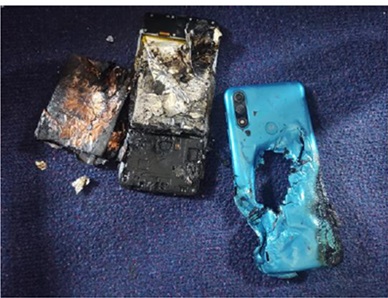
The cabin crew promptly initiated procedures for handling LIB fires, utilizing water, handheld BCF fire extinguishers, fireproof gloves, and breathing equipment. The flight crew was informed, and an emergency (“MAYDAY”) was declared. The fire was extinguished by cooling the phone with water, after which it was secured in a metal container filled with water and placed in an aft lavatory for monitoring. The flight proceeded without further incidents, and the damaged phone and carpet were documented
“During a Thermal Runaway fire, the temperature in the cell can reach 900 °C, and the jet flame can exceed 1000 °C”
Lithium-ion battery fires, such as the one in this incident, occur when the temperature in a battery cell exceeds approximately 80°C, triggering a self-sustaining chemical heat reaction known as thermal runaway. This can result from external heat, overcharging, deep discharge, or short circuits caused by cell contamination, external damage, or dendrite formation during low-temperature charging. Thermal runaway generates heat that propagates to other cells, releasing flammable, toxic, and acidic gases, as well as oxygen, which sustains the fire. The temperature can reach 900°C, with jet flames exceeding 1,000°C. The report includes experimental data illustrating the progression of thermal runaway and its associated hazards.
Aircraft are equipped with mandatory fire extinguishers, portable breathing equipment, and standard emergency tools specified by manufacturers like Airbus and Boeing. While fireproof gloves are standard in cockpits, they are not always available in cabins. Operators are required to have procedures and equipment to manage LIB fires, although the specific contents of fire kits are not standardized. The airline’s battery fire kit includes heat-resistant gloves, special extinguishers for cooling, and fire-resistant containment bags designed to cushion explosions. Additionally, the company equips its aircraft cabins with extra fireproof gloves.
The NSIA assessed the incident and highlighted the challenges posed by LIB fires, which develop differently from other types of fires. Thermal runaway represents significant health risks and damage potential, with rapid temperature increases and the release of hazardous gases. Early intervention is crucial to achieve sufficient cooling and suffocation to stop the fire. Crew members must have readily accessible equipment, proper training, and the ability to act quickly. Protective gloves are essential for handling hot or burning batteries, while adequate care must be taken since damaged LIBs can reignite at any time.
The NSIA commended the Wizz Air crew for their swift and effective response, noting that they had the necessary equipment, and followed proper procedures to control the situation until landing. The report recommends that all passenger transport operators equip both cabins and cockpits with easily accessible fire-protective gloves and comprehensive LIB fire kits. Regular training in handling thermal runaway and LIB fires is also emphasized. However, the NSIA did not propose any formal safety recommendations in this report.
The investigation underscores the importance of preparedness and training in managing LIB fires, which pose unique challenges due to their self-sustaining nature, and potential for severe damage. The incident serves as a reminder of the critical role of crew readiness and equipment in ensuring passenger safety during emergencies.
Read the full NSAI report here:
https://nsia.no/Aviation/Published-reports/2024-07
Update: a similar incident occurred on 20 March 2025 aboard Airbus A320, B-LPC, from Hangzhou/Jianqiao, China to Hong Kong/Intl.
The following preliminary data is based on the notification from the authorities of China:
During cruise phase, a power bank in a passenger’s carry-on luggage spontaneously combusts in the overhead cabin compartment. The cabin crew executed the fire extinguishing procedures and successfully put out the fire. It was confirmed that the occurrence was caused by thermal runaway of a power bank which has been verified that was a Romoss-branded device with a rated capacity of 20,000 mAh, which is allowed to be carried on board aircraft. The flight crew decided to divert to Fuzhou Airport, which is the nearest airport, and the aircraft landed uneventfully.