The Importance of using English to Maintain Situational Awareness
On February 8, 2012, a serious air traffic incident occurred near Barcelona Airport involving two commercial aircraft: an Airbus A330 operated by Iberia and an Airbus A319 operated by Brussels Airlines. Both aircraft were on approach to land on the same runway when an error by air traffic control led them dangerously close to one another, triggering automated collision avoidance systems on both planes.
The situation developed as both aircraft were descending towards runway 25R at Barcelona El Prat Airport. The A330 was following the A319, but was flying slightly faster. Air Traffic Control opted to change the sequence of landings by attempting to reroute the A330. This manoeuvre, however, brought the aircraft into conflict with the A319, which had not yet completed its approach.
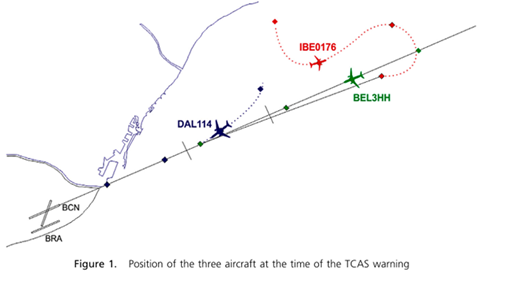
One of the major challenges during this incident was the difference in the language used by the controller when speaking to each aircraft. Communications with the A330 were in Spanish, while the A319 crew, who were non-Spanish speakers, received instructions in English. This created a lack of shared situational awareness, especially for the crew of the A319, who were not aware of the proximity of the other aircraft, and had no visual contact due to the weather, and their position.
“The controller addressed BEL3HH in English and IBE0716 in Spanish for the duration of the manoeuvre”
As the aircraft continued on their paths, their on-board systems detected the danger. Both aircraft were equipped with TCAS (Traffic Collision Avoidance System), which issued urgent commands: the A330 was told to climb, and the A319 to descend. The pilots followed these commands immediately, thus preventing a potential collision. At the closest point, the two aircraft were separated by only 1.4 nautical miles horizontally and 400 feet vertically—well below safe minimum standards.
The Spanish aviation authority launched a thorough investigation into the incident. It was found that the primary cause was the controller’s poor judgment in trying to resequence the aircraft for landing without ensuring they remained safely separated. The decision to assign a left turn to the A330, bringing it across the A319’s path, was especially identified. Investigators stated that a right turn would have been far safer, and more effective, in avoiding conflict.
There were also systemic issues that contributed to the situation. One key safety system in the air traffic control environment, known as the Short Term Conflict Alert (STCA), which warns controllers of imminent collisions, had been disabled below a certain altitude to reduce false alarms. Unfortunately, this meant that it could not trigger during this critical phase of flight, leaving the controller without automated backup in detecting the danger.
In the end, the quick and correct response of the pilots, and the effectiveness of the TCAS prevented a disaster. However, the incident served as a clear warning about the importance of clear communication, thoughtful planning in air traffic control, and ensuring that safety systems remain active and reliable during all phases of flight.
To prevent similar incidents, AENA investigators recommended that “when any doubt exists as to anyone’s ability to understand Spanish, or during conflict situations involving an aircraft whose crew does not speak Spanish, to conduct radio communications in English so that everyone involved has accurate information on the situation”. They further emphasised that “English shall be used at the request of any aircraft station, at all ground stations serving designated airports and routes used by international air services”.
AENA also urged that controllers be trained more thoroughly in how to plan and manage potential aircraft conflicts, particularly when sequencing arrivals.
Read the whole CIAIAC report here:
https://skybrary.aero/bookshelf/report-0072012-english-loss-separation-between-a330-and-a319-near-barcelona-8-feb-2012